

EV Charger Installation
Planning a Charging Circuit Around the Panel
Delco Park Electric plans and wires the dedicated circuits that home electric vehicle chargers run on, for houses and small businesses in Kettering and the neighboring communities. The charger itself is the simple part. What decides the job is the building’s electrical service: how much capacity the panel has left, how far the charger sits from it and the route a heavy circuit can take to reach the parking spot.
What Shapes the Installation
- Panel capacity. A Level 2 charger can draw 32–48 amps for hours. A load calculation adds up the building’s existing demand, from heating and cooling to cooking and drying, to show whether the service can carry the charger too.
- Circuit size. The code sizes a charger circuit at 125 percent of the charger’s continuous draw: a 32-amp charger needs a 40-amp circuit, a 40-amp charger a 50-amp circuit and a 48-amp charger a 60-amp circuit.
- Distance and route. The length of the run sets the wire size, and the route, along a garage wall, through a basement ceiling or underground, sets how the cable is protected.
- Garage or driveway. A garage charger usually mounts on a wall near the charge port; a driveway location needs equipment rated for outdoor use and often a buried conduit run.
- Permit. A new 240-volt circuit generally requires a permit and an inspection by the local building department.
On the visit, the proposed charger location is looked at together with the panel, so the circuit size and the route are settled before any work begins. The stages of a job are set out under How We Work.
Charger Sizing Guide
Choose the panel size, the charger and the distance from the panel to see what that combination usually means. The guidance is general; the panel and the route are confirmed in person.
Wiring a Level 2 Charger Circuit
Most home charging installations are a single dedicated 240-volt circuit from the main panel to the charger, protected by a two-pole breaker sized to the charger’s draw. The conductors follow the breaker: 8-gauge copper is typical for a 40-amp circuit and 6-gauge for a 50-amp circuit, with a 60-amp circuit on 6-gauge in conduit or 4-gauge cable.
Plug-In and Hardwired Chargers
A plug-in charger connects to a 240-volt receptacle, most often a NEMA 14-50 on a 50-amp circuit, so it can be unplugged and replaced easily. Current code calls for ground-fault protection on receptacles installed for vehicle charging, and some chargers with their own internal protection trip a GFCI breaker. A hardwired charger connects directly to the circuit and avoids the receptacle altogether; chargers drawing 48 amps on a 60-amp circuit are always hardwired.
Routing the Circuit
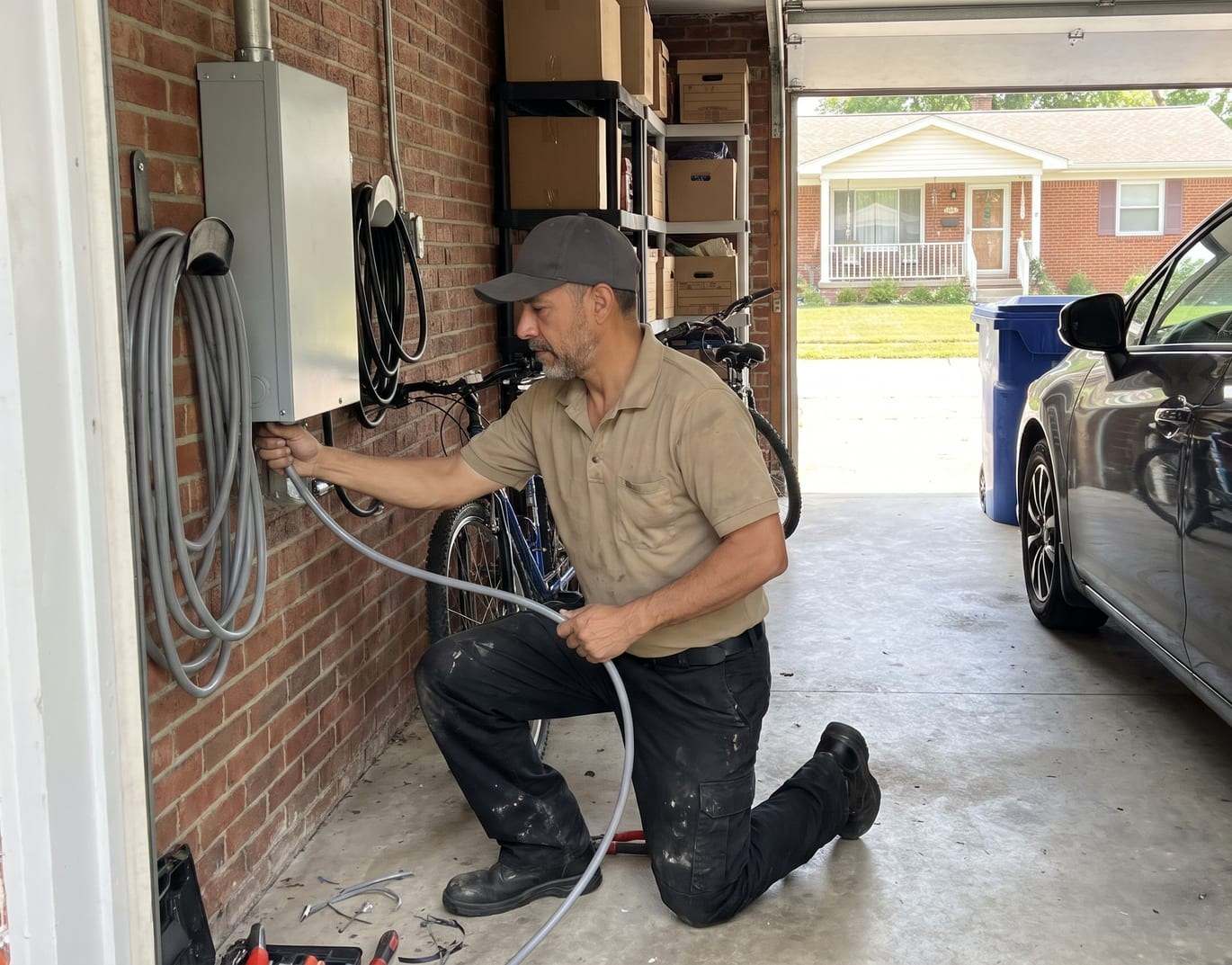
With the panel on a shared garage wall, the run may be only a few feet. In many Kettering ranch houses the panel sits in the basement, and the circuit travels through the ceiling joists and up into the garage wall, a route often shorter than the straight-line distance suggests. A driveway post or a detached garage means a trench, with conduit buried at the depth the code requires. Runs well beyond 50 feet are checked for voltage drop, which can call for a conductor one size larger than the breaker alone would require.
When the Panel Needs Help
If the load calculation shows too little spare capacity, the usual answers are a smaller circuit, a load-management device that reduces charging while the house draws heavily, or a larger service, explained under panel and service upgrades.
Details That Help Plan a Charger Circuit
- The vehicle’s maximum charging rate at home, set by its onboard charger
- Whether the charger plugs in or hardwires, if one has already been chosen
- Where the car parks and which side its charge port is on
- The rating printed on the panel’s main breaker
- Large electric appliances in the house: range, dryer, water heater, heat pump or electric furnace
Level 1 and Level 2 Charging Compared
Most questions about home charging come down to how fast the car needs to charge and what the building can supply. These answers describe the general picture.
- What is the difference between Level 1 and Level 2 charging?
- Level 1 uses a standard 120-volt outlet and the cord set supplied with most vehicles, drawing about 12 amps and adding roughly 3–5 miles of range per hour. Level 2 uses a 240-volt circuit and a wall-mounted charger drawing 32–48 amps, adding roughly 20–45 miles per hour, depending on the charger and the vehicle.
- Is Level 1 charging enough for daily driving?
- For moderate daily distances and a car parked overnight for ten hours or more, often yes. Long commutes, larger vehicles and households with two electric vehicles usually need Level 2.
- What kind of outlet does a Level 1 cord need?
- It needs a sound, grounded outlet, ideally on its own 20-amp circuit, because the cord draws a steady load for hours. Garage and outdoor outlets require GFCI protection, and worn outlets and extension cords are a common source of overheating. Outlet types are covered under outlets, switches and wiring.
- Is a 60-amp circuit always better than a 40-amp circuit?
- No. A vehicle charges no faster than its onboard charger allows, and many accept no more than 32 or 40 amps, while a larger circuit takes more of the panel’s capacity. The circuit is best matched to the vehicle and the panel.
- Can a charger be mounted outside?
- Yes, when the charger is rated for outdoor use and the circuit runs in weatherproof conduit and fittings. A sheltered spot with a hook for the cable keeps the connector clear of rain and winter ice.
- Does a charger installation need a permit?
- In most jurisdictions a new 240-volt circuit requires an electrical permit and an inspection, set by the building department that covers the address. A service upgrade made for the charger is permitted and inspected as well.
Starting a Charger Plan
A charger plan begins with the panel. Call (937) 719-8299 or send a request with the vehicle, the charger if one has been chosen and where the car parks; the office asks a few questions and then sets a time.